Author Archives: colonelgrape

2008 Trimbach Gewurztraminer

Image

Here we have our first Gewurztraminer on the website. This is a white grape (even though its kind of red/pink looking on the vine) that is primarily grown in Alsace, France. It is grown elsewhere but the best examples almost always come from Alsace. It’s known for it’s spicy sweetness, floral, and fruit aromas. The grape itself is very finicky which probably has to do with it’s limited success outside of Alsace. It can be made into a wide array of wines from the very dry to the very sweet, it all depends on when the grape is harvested. It can also be effected by noble rot similar to the whites from Sauternes. Often times Gewurztraminer is paired with spicy, fatty, and oily meals…Asian cuisine is the most common pairing.

Another common way to serve Gewurztraminer is as an aperitif. We like to serve it both ways but in this case we had it with Moby’s home made porketta.

colonelgrape: 89. This was a very good bottle and an example of a dryer Gewurztraminer. It still had that sweetness and spice depth to it but there was no upfront sweetness…this is the kind I’d prefer to have with my meal whereas the sweeter versions go better as an aperitif. Porketta was the perfect meal to go with it because there was fat and spice and the wine cut it perfectly. We were rationing out the wine because it was going so fast. At only $20 this is a great buy…if you’ve never tried a Gewurz you need to try one ASAP…you haven’t had anything like it yet.

MobyGrape – 93.  The first time I tried this type of wine I had boogers blocking 93% of my nostrils’ capacity and had severely impaired senses of smell and taste, but I could swear I was tasting greatness.  I was super excited to try it again and this did not disappoint.  It wasn’t exactly what we had the first time but it reminds me very much of it.  There’s a deep kind of sweetness to it, it’s not sicky candy sweet, it’s more of a spicy sweet.  LIke when you’re wearing your fancy underwear under sweatpants.  You know there’s more going on under there than meets the eye, you’re just daring your husband to go ahead and try.  You feeling lucky, punk?  Might be granny panties, then again, might not…But I digress.  We had it the first time with gougere followed by assorted cheeses and crackers, but I feel like it could hold its own with lighter meat.
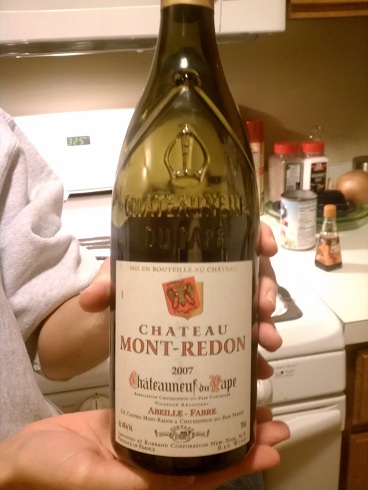
2007 Chateau Mont-Redon Chateauneuf du Pape

Image

Sometimes you want to go where everybody knows your name…and they’re always glad you came.

Chateauneuf du Pape brings us back to 80’s television. It’s safe to say that Chateauneuf is our favorite wine region here at Grapestorm. It’s pricey but when you buy from a reputable producer in a good vintage you are in for a treat. It has body, structure, character, and it’s incredibly fun to say. Moby and I will literally walk around the house just saying “CHATEAUNEUF DU PAPE” in our best hoity toity french voices for hours on end…we are that cool. It’s kind of a funky name so let me help you pronounce it properly: SHA-TOH-NUF DO PAHP.

Now that you know how to say it let’s talk about producers. Chateau Mont-Redon is not the best producer in CdP but their wines are of high quality at great value. A bottle of 2007 Chateau de Beaucastel, Vieux Telegraph, Vieux DonJon, or Rayas may cost you $100+ but this Mont-Redon was only $45 and worth every drop. Don’t get me wrong, the producers I just mentioned produce world class wines that are exceptional but they are tough to get your hands on at a reasonable price. One thing to be very careful of when buying a CdP is the cheap bottle from an unknown producer. These wines can be absolutely terrible and you’ve wasted $25. Why are they so bad? Because CdP is a blend of grapes (typically Grenache, Syrah, and Mourvedre…Cinsault, Counoise, Muscardin, Terret Noir, and Vaccarese are also allowed) and inferior producers use more of the inferior grapes to save money. I can’t recommend CdP enough but you need to do your research before going to the store. I have yet to have a good CdP that cost under $40. Our two favorite “value” producers are Chateau Mont-Redon and Bosquet des Papes.

Vintage is also very important when buying CdP. Wines can vary vintage to vintage in CdP more so than in other regions. Recent good vintages: 98, 00, 01, 05, 07, 10. Avoid any 02 or 08 you may find. 2007 was an especially interesting year in Chateauneuf du Pape…it was an extremely hot summer so the grapes were riper than normal producing a bigger,  more alcoholic, more fruit forward wine. Many people taut it as one of the best vintages of all time while some people don’t like it because it was so different. The way I see it if you like California Cabernet you’ll like 2007 Chateauneuf. You’ll have to be the judge for yourself!

colonelgrape: 97. Wow. This wine is out of this world and for only $45. A beautiful ruby color with smells of ripe plums and earth. On the palate it was medium bodied with tastes of ripe black fruits and berries with acidity to balance everything out. The tannins weren’t out of control but it was definitely more ripe and boozy than a usual CdP but it worked well. The finish was long and delicious. We had this wine with roast beef and mashed potatoes and it was a great pairing. This will stand up to roasted meat and vegetables all night long. One of the best wines I’ve had in recent memory at this price point.

MobyGrape: 96. The first thing that came to mind when drinking this wine is that it was sort of hollow.  Like there was an excellent smooth flavor up front, gave your mouth an awesome party, and then sort of poofed and left a superb, lingering flavor.  And maybe it was all the wine or the poofing but all I could think of was David Copperfield.  This wine is like David Copperfield.  You get a magical show that will dazzle your tastebuds and then poof!  The sip of wine is already gone but the flavor is still deliciously hanging around and somehow he pulled a duck out of a hat.  Bravo!  I’m told 2007 was a bit of a goofy year for Chateaneuf’s, and some people aren’t a fan.  I think I should change my rating because you know what, maybe no one else should drink this, I don’t want anyone risking it.  I’ll just take one for the team and drink all of them myself.  Go ahead, send all of your 2007’s to me.

2010 Louis Latour Chameroy Beaujolais-Villages

Image

Here we have a great little Beaujolais from Louis Latour. We haven’t covered any of his wines yet on the blog but he’s a very well known negociant in Burgundy. This is a Beaujolais-Villages which means the grapes were selected from certain villages with higher quality than a regular Beaujolais. The result is a more full bodied and flavorful wine that will have more structure than a standard Beaujolais.

Being a Beaujolais-Villages this will stand up to a medium meal nicely and you can pick one of these bottles up for about $15. We had it with sausage, peppers, and onions.

colonelgrape: 92. This was the best bottle of Beaujolais I’ve ever had. That’s not saying a whole lot but I’ve had some bad ones in the past. It had a nice medium body with a deep garnet color. It tasted of red fruit with good acid and very mild tannins…fuller bodied than a regular Beaujolais. I would definitely recommend this bottle if you like Beaujolais…it’s a great wine to keep around for a night where you want wine but don’t want to break the bank.

MobyGrape: 90*.  I gave this one an astersisk for the record books not because of any potential steroid shenanigans that could taint its record, but quite frankly I didn’t write this review soon enough and forgot the finer points of this wine other than it was really good.  I worked late this night and came home like a ravenous thirsty beast.  Thankfully, the Colonel had sausage, peppers, and onions waiting for me with an open bottle of this puppy.  I guzzled a couple glasses of it, and when I finally came up for air I realized it was really tasty, but I wasn’t quite sure what I actually tasted.  I even had the rest the next day with the intention of paying attention but sure enough I saw the glass and *chug*, it was gone.  Oops, I did it again.

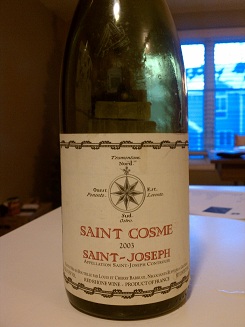
2003 Saint Cosme Saint-Joseph

Image

Saint-Joseph is an appellation in the Northern Rhone Valley that grows Syrah. It’s kind of an odd appellation in that it’s very long and narrow on the West bank of the Rhone river. It is the second largest appellation in Northern Rhone second only to Crozes-Hermitage. Saint-Joseph is frequently compared to Crozes-Hermitage in wine style and it’s easy to see why…they grow the same grapes and are in a similar region, albeit on opposite sides of the river.

The odd geography of the appellation leads to inconsistency of the wines…but not necessarily in a bad way. Classic Saint-Joseph comes from the southern part of the region while the wines from the north may taste very different as the terrior of the appellation changes. The wines of Saint-Joseph were described to me like a “mild version of Crozes-Hermitage” and are often thought of as wines to drink while waiting for Cote-Rotie and Hermitage wines to mature.

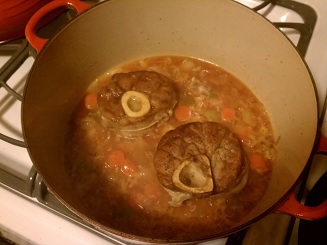
With their mild nature they drink well young but excellent examples are worthy of cellaring such as the 2003 we had the other night. This is a $50 bottle from Vin Bin’s fine and rare December collection. We enjoyed it with veal osso buco, rice, and vegetables:

Image

If you’ve never tried osso buco and you’re a meat lover you are missing out. It’s tender, flavorful, and very interesting. Also if you have a dog they will swim across the ocean and back for one of the shank bones…seriously they absolutely love them.

colonelgrape: 93. I really enjoyed this wine. We decanted it for about 45 minutes to let it open up and It was a nice ruby color, full bodied with flavors of red fruit and leather. Definitely not as bold as Cote-Rotie wines but you could tell it was Syrah. If you have a bottle of this drink it now, I don’t see it getting any better with more aging.

MobyGrape: 90. This one decanted for a while, so I was ready to dive in and see what was going on, I figured all the riff raff would be out by the time I stuck my schnozz in it.  I went to give it a good whiff and immediately was transported to the dump in the town I grew up in.  If you’ve never been to a dump before, you’re missing out, and if you have, you know it has a very distinct odor.  It just smells…different.  Then I tasted it and thought those salivary glands in the lower corners of my mouth were going to explode.  I’m told that’s acid.  At this point you’re probably thinking my rating was a typo.  In that weird journey that wines take in the glass however, the dumpy smell mostly went away and so did the cheek-shattering acidity and it mellowed out and became a drier, tart wine that tasted quite nice.  Like the knight guarding the Holy Grail in Indiana Jones, he was all old and fierce looking at first, then he drops his sword when he’s trying to swing it and you realize he’s just a kind old man doing his job and he recognizes Indy’s a pretty good guy after all.  Am I saying I’m like Indiana Jones?  I’m not saying that I’m not.  Who doesn’t enjoy a good archealogical adventure?  Isn’t that what wine tasting is all about anyways?  With every sip you’re tasting a wet little piece of the past.  This wine was from 2003.  It will never happen again.  None of the wines you drink will ever happen again.  Except for that Beaujolais Nouveau crap, that’s just unnatural and will probably continue to be crap until the end of time.  Regardless, I got to be a part of what these people were doing at that time, in that place, during those exact conditions in which these grapes grew.  Whoa.

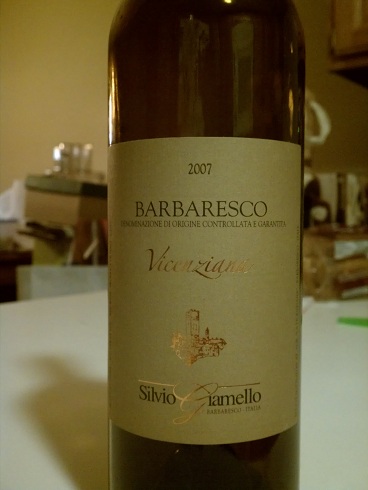
2007 Silvio Giamello Vicenziana Barbaresco

Image

Barbaresco is made from the Nebbiolo grape in Piedmont. You might be thinking that sounds familiar and you’d be right because Barolo is also made with the same grape in the same region.  In fact, these two wines are produced as close as 10 miles apart in some vineyards.

While they share many similarities there are also differences between the two wines hence two seperate classifications. The main difference is the terrior, or effect the land has on the product, of the wine. Barbaresco is grown in a more southern and maritime climate therefore the grapes reach ripeness sooner. This allows earlier fermentation and a wine with softer, albeit still strong, tannins. Barbaresco is approachable sooner than a Barolo but doesn’t have quite the aging potential. These are all subtle differences though and the only way to really experience the difference is to try multiple examples of each wine and see for yourself. I purchased this bottle at the Wine Library for $35 and we weren’t disappointed. We enjoyed it with rigatoni with meat sauce and garlic bread.

colonelgrape: 91. Like most big wines (Cabernet, Barolo, Barbaresco, etc) I would recommend decanting for at least 30-60 minutes prior to drinking. This will allow the tannins to soften, the flavor to come out, and the wine to reach a more appropriate drinking temperature. Right away I tasted notes of cherry, earth, leather and Moby detected hints of anise. Definitely a classic Nebbiolo wine. The tannins gave the wine structure but weren’t in your face after decanting. The finish was long and pleasant. This wine is very drinkable right now and over the next few years. I’d recommend it with a rustic meal like osso buco, porketta, or lasagna.

MobyGrape: 87. Let this one breathe for a minute before you drink it, the first sip right away (because I couldn’t wait, obviously) was super dry and kind of sour tasting but it really turns around after a few just hanging out. I picked up a kind of musty earthy anise taste and smell, but not in a bad way, it was subtle like a nicely flavored cookie kind of way, not like chewing on a piece of licorice.  Then I heard the Colonel mention cherry, and I certainly pick that up as well, but it wasn’t overly fruity, or like drinking a cherry you picked up off the ground.  I know this sounds like an odd combination but trust me, it’s quite good, and the flavors work well together.