Category Archives: Champagne

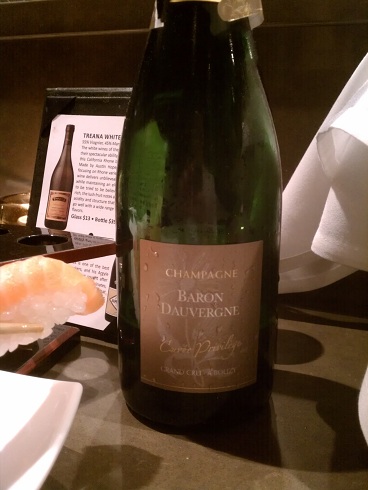
Baron D’auvergne Brut Privelege

Image

Last night we had our first Champagne of 2013 and it was the Baron. We were out celebrating Moby’s birthday (21 again of course) and we decided to get sushi. UncleGrape has been raving about the pairing of sushi and champagne so we gave it a try and it didn’t disappoint. You can even see some sushi Moby snuck into the photo. I think the reason the pairing works so well is the lightness of both foods….no overpowering flavors just refreshing and light.

My last order from Wine Library was all whites and this bottle was one of them. What’s different about this bottle is the blend is 80% pinot noir and 20% chardonnay whereas most champagnes are chardonnay or the ratio is reversed. I have another bottle of champagne in the cellar that’s 100% chardonnay so we’ll have an interesting comparison…as was the Nicholas Feuillate we had on New Years Eve.

colonelgrape: 87. I’m still struggling to find my champagne palate but it’s coming along. I could definitely distinguish the quality in this wine vs. the Nicholas Feuilatte we had a few weeks ago. The bubbles were just right and the wine was just tighter. I like to have Brut with food and usually by the time I get 1/2 way through I’m over it but I made it almost all the way through this bottle before that happened. I could really taste the difference the pinot noir makes because it allows you to taste red berries in the background like strawberry and raspberry while the focus is on more golden fruit like pear, apple, and melon. I really enjoyed it with the sushi as they were both light and refreshing at the same time. We tried sea urchin for the first time and that even worked with the wine. All in all the Baron is a delicious bottle of champagne and I’m looking forward to trying more to compare it with. Expect sushi/champagne nights to keep popping up in the future and hopefully I’ll have more of a grasp on champagne.

MobyGrape: 84.  I’m finding myself very torn writing these champagne reviews.  It’s like looking at a famous work of art that you can appreciate as an incredible artistic creation….but you don’t really like.  You’ll never admit that you don’t like it, because you’d then be known as the uncultured idiot who doesn’t like fine art, but deep down, as hard as you may try, it just doesn’t do anything for you.  That’s how I feel about some of the champagnes we’ve had.  I can appreciate them, and they make me feel fancy, but I don’t always want to hang them on my living room wall.  For whatever reason, I still like my sweet bubblies for all occasions.  Yes, they may be the color-by-numbers of the art world, but there’s no accounting for taste, is there.  If you like dry champagne/sparkling wines, by all means have at it, I admire your style!  If you’re like me though, make sure to pair those with food, they complement each other better that way.  Personal preferences aside, I consider it my solemn duty to keep on popping corks until I can appreciate the Brut equivalent of the Mona Lisa.
Nicolas Feuillatte Brut Reserve

ImageImage

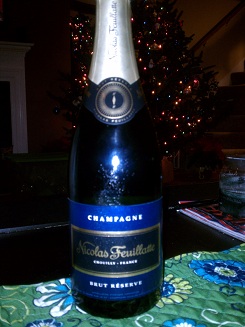
Happy New Years from Grapestorm! This year on New Year’s Eve I picked up a bottle of Nicholas Feuillatte Brut Reserve Champagne on the way home from skiing. There’s a lot to cover when talking about Champagne:

In order for a wine to be called Champagne it must come from Champagne, France. All other sparkling wines world wide may not be called Champagne technically…although many people make that mistake on a regular basis. Champagne located north of Burgundy and East of Alsace.

Champagne is typically made with a blend of Chardonnay and Pinot Noir grapes. You might be wondering how they make white wine with a red wine grape but the secret is how they press the grapes. They press them gently and separate the juice from the skins during fermentation therefore yielding a white wine. There are other varietals allowed in Champagne but they are rarely used: Arbanne, Petit Meslier, Pinot Blanc, Pinot Gris, and Pinot Meunier.

Some versions of Champagne are made entirely from one grape or another. Blanc de Noirs refers to wine made from red grapes (Pinot Noir or Pinot Meunier) while Blanc de Blanc refers to wines made from 100% Chardonnay. Rose Champagne is made by either a) allowing skin contact during fermentation or b) simply adding still (non-sparkling) Pinot Noir to the mixture. In fact Champagne is one of the only regions that allows Rose production by addition of wine and not skin contact.

This leads to another important fact about Champagne: There aren’t vintages on the bottles. Almost all Champagne is produced by mixing grapes from various vintages. Producers are more concerned with consistency rather than having a unique wine from year to year. This is one of the reasons they may add still Pinot Noir to produce Rose rather than gamble with skin exposure as that may come out different year to year. There are exceptions to this rule though and every so often there is a spectacular vintage a Millesime is declared and producers will bottle and label  their wines with only grapes from that vintage. These wines are expected to be of higher quality and warrant cellaring where regular Champagne is meant to be consumed immediately.

The label will tell you whether you’re buying a sweet or dry Champagne:

Brute Nature (no sugar added)

Extra Brut

Brut

Extra Dry

Dry

Demi-Sec

Doux (Sweet)

The most common variety you’ll find on the shelf is Brut. Also important is that many producers are known for making different styles ranging from light to medium to full bodied wines. Unfortunately the only way to know what you’re buying is to learn the producers or ask for help at the store.

Lastly, let’s talk about how to properly open a bottle of Champagne. We always see in the movies or on TV people popping open the bottle, cork goes flying, and fizz erupting from the bottle. That’s not how you do it….all that fizz/foam is wasted bubbles and wine! Here’s how to do it properly: First step is to remove enough of the foil to expose the wire net. Carefully remove the wire while maintaining pressure on the cork. While holding the cork rotate the bottle in your hand at an angle to gently ease out the cork. While it may not be as glamorous and fun…this will prevent cork missiles, flat, and wasted wine.

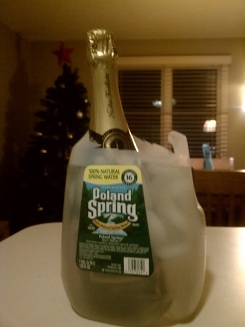
Champagne is meant to be served chilled just like other white wines. The classic method is an ice bath of 50% mix of ice/water for 20-30 minutes. However here at the Grape household we like to get creative sometimes. Since we don’t drink Champagne often we don’t have an ice bucket so I made my own while Moby was still at work. I took a gallon water contained, cut off the top, and voila…instant ice bucket.

colonelgrape: 81. I’m not a huge Champagne fan, most bottles just don’t do it for me. It has 2 strikes against it before I even open a bottle: I don’t like Chardonnay or carbonated beverages too much. That being said I can appreciate a good bottle when I taste one and nothing says celebration like Champagne. This bottle was definitely on the dry side of Brut but it was still fun. Moby definitely enjoys her bubbly more than I do but for New Year’s, a wedding, a Birthday, or a major accomplishment no drink does it better. If you’re looking for a light-medium body Brut Champagne you’ll do well with this $35 Nicolas Feuillatte. Personally I think I’d be happier with a dry or demi-sec to cut the Chardonnay flavor a bit.

MobyGrape: 80.  I’ll be the first to admit, I do enjoy a nice glass of the bubbly.  There’s just something about drinking a glass of champagne (or sparkling wine, if you’re a snob like the Colonel) that makes you feel happy and fancy.  Even if you’re drinking it while in your pajamas eating pizza, (not that I’ve ever done that) you feel like you’re a Bond girl.  This was definitely a drier champagne which isn’t really my style, however it didn’t stop me from drinking 3/4 of the bottle because it still had a nice flavor.  If you want something sweeter though, steer clear.  Happy new year to me!