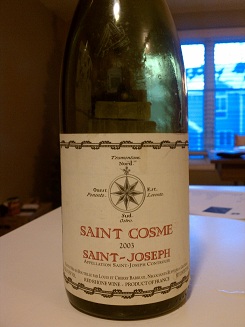
2003 Saint Cosme Saint-Joseph

Image

Saint-Joseph is an appellation in the Northern Rhone Valley that grows Syrah. It’s kind of an odd appellation in that it’s very long and narrow on the West bank of the Rhone river. It is the second largest appellation in Northern Rhone second only to Crozes-Hermitage. Saint-Joseph is frequently compared to Crozes-Hermitage in wine style and it’s easy to see why…they grow the same grapes and are in a similar region, albeit on opposite sides of the river.

The odd geography of the appellation leads to inconsistency of the wines…but not necessarily in a bad way. Classic Saint-Joseph comes from the southern part of the region while the wines from the north may taste very different as the terrior of the appellation changes. The wines of Saint-Joseph were described to me like a “mild version of Crozes-Hermitage” and are often thought of as wines to drink while waiting for Cote-Rotie and Hermitage wines to mature.

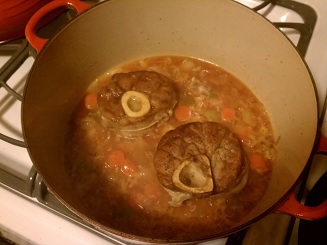
With their mild nature they drink well young but excellent examples are worthy of cellaring such as the 2003 we had the other night. This is a $50 bottle from Vin Bin’s fine and rare December collection. We enjoyed it with veal osso buco, rice, and vegetables:
Image

If you’ve never tried osso buco and you’re a meat lover you are missing out. It’s tender, flavorful, and very interesting. Also if you have a dog they will swim across the ocean and back for one of the shank bones…seriously they absolutely love them.

colonelgrape: 93. I really enjoyed this wine. We decanted it for about 45 minutes to let it open up and It was a nice ruby color, full bodied with flavors of red fruit and leather. Definitely not as bold as Cote-Rotie wines but you could tell it was Syrah. If you have a bottle of this drink it now, I don’t see it getting any better with more aging.

MobyGrape: 90. This one decanted for a while, so I was ready to dive in and see what was going on, I figured all the riff raff would be out by the time I stuck my schnozz in it.  I went to give it a good whiff and immediately was transported to the dump in the town I grew up in.  If you’ve never been to a dump before, you’re missing out, and if you have, you know it has a very distinct odor.  It just smells…different.  Then I tasted it and thought those salivary glands in the lower corners of my mouth were going to explode.  I’m told that’s acid.  At this point you’re probably thinking my rating was a typo.  In that weird journey that wines take in the glass however, the dumpy smell mostly went away and so did the cheek-shattering acidity and it mellowed out and became a drier, tart wine that tasted quite nice.  Like the knight guarding the Holy Grail in Indiana Jones, he was all old and fierce looking at first, then he drops his sword when he’s trying to swing it and you realize he’s just a kind old man doing his job and he recognizes Indy’s a pretty good guy after all.  Am I saying I’m like Indiana Jones?  I’m not saying that I’m not.  Who doesn’t enjoy a good archealogical adventure?  Isn’t that what wine tasting is all about anyways?  With every sip you’re tasting a wet little piece of the past.  This wine was from 2003.  It will never happen again.  None of the wines you drink will ever happen again.  Except for that Beaujolais Nouveau crap, that’s just unnatural and will probably continue to be crap until the end of time.  Regardless, I got to be a part of what these people were doing at that time, in that place, during those exact conditions in which these grapes grew.  Whoa.
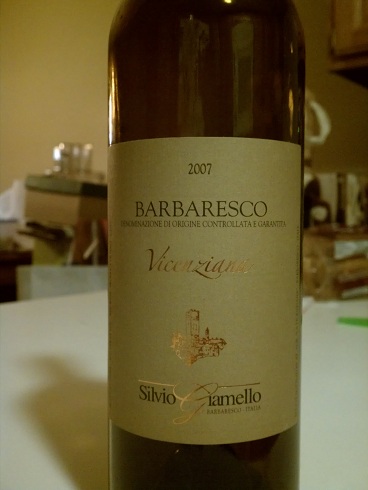
2007 Silvio Giamello Vicenziana Barbaresco

Image

Barbaresco is made from the Nebbiolo grape in Piedmont. You might be thinking that sounds familiar and you’d be right because Barolo is also made with the same grape in the same region.  In fact, these two wines are produced as close as 10 miles apart in some vineyards.

While they share many similarities there are also differences between the two wines hence two seperate classifications. The main difference is the terrior, or effect the land has on the product, of the wine. Barbaresco is grown in a more southern and maritime climate therefore the grapes reach ripeness sooner. This allows earlier fermentation and a wine with softer, albeit still strong, tannins. Barbaresco is approachable sooner than a Barolo but doesn’t have quite the aging potential. These are all subtle differences though and the only way to really experience the difference is to try multiple examples of each wine and see for yourself. I purchased this bottle at the Wine Library for $35 and we weren’t disappointed. We enjoyed it with rigatoni with meat sauce and garlic bread.

colonelgrape: 91. Like most big wines (Cabernet, Barolo, Barbaresco, etc) I would recommend decanting for at least 30-60 minutes prior to drinking. This will allow the tannins to soften, the flavor to come out, and the wine to reach a more appropriate drinking temperature. Right away I tasted notes of cherry, earth, leather and Moby detected hints of anise. Definitely a classic Nebbiolo wine. The tannins gave the wine structure but weren’t in your face after decanting. The finish was long and pleasant. This wine is very drinkable right now and over the next few years. I’d recommend it with a rustic meal like osso buco, porketta, or lasagna.

MobyGrape: 87. Let this one breathe for a minute before you drink it, the first sip right away (because I couldn’t wait, obviously) was super dry and kind of sour tasting but it really turns around after a few just hanging out. I picked up a kind of musty earthy anise taste and smell, but not in a bad way, it was subtle like a nicely flavored cookie kind of way, not like chewing on a piece of licorice.  Then I heard the Colonel mention cherry, and I certainly pick that up as well, but it wasn’t overly fruity, or like drinking a cherry you picked up off the ground.  I know this sounds like an odd combination but trust me, it’s quite good, and the flavors work well together.

December Recap

Image

It was a great December and It’s time for our first monthly recap! We will list all the wines we rated as well as any other wines we tried. If any of the wines we tried but didn’t rate were bad we will make note of it. The ratings listed are the average of our two ratings per wine rounded up.

Grapestorm Highest Rated Wine of December 2012: 

2005 Chateau Laribotte Sauternes – 94

Wines Rated:

2008 Frogs Leap Cabernet Sauvignon – 91

2011 Soria Bruno Cascina del Santuario Moscato d’Asti – 87

2010 Michele Chiarlo Barbera d’Asti – 87

2005 Cerro Anon Rioja Reserva – 85

Nicolas Feuillatte Brute Reserve – 81

2005 Pere & Fils Volnay 1er Cru Clos des Chenes – 81

2011 Saint-Peyre Picpoul – 80

2010 Josh Cabernet Sauvignon – 78

2010 Walnut City Wineworks Pinot Noir – 77

2011 Valle D’Oro Montepulciano d’Abruzzo – 76

2011 Olivier Morin Chitry Bourgogne – 73

2010 Hugel Gentil – 72

2011 Lous Jadot Macon-Villages – 70

2008 Felsina Chianti Classico – 40

Other Wines Enjoyed:  

2007 Opolo Vineyards Mountain Zinfandel – Not great, would not recommend.

2006 Domaine Weinbach Cuvee Laurence Gewurztraminer

2010 Rene Dauvissat Chablis

2000 Domaine Charvin Chateauneuf du Pape

1998 Vieux Telegraph Chateauneuf du Pape

2000 Domaine de la Janasse Chateauneuf du Pape

1998 Domaine Font de Michelle Cuve Etienne Gonnet Chateauneuf du Pape

1977 Taylor’s Vintage Port

2010 Renato Ratti Barbera d’Alba

2009 Camp du Rouss Barbera d’Asti

2011 Bovio Barbera d’Alba

2012 Sunday River Sauvignon Blanc

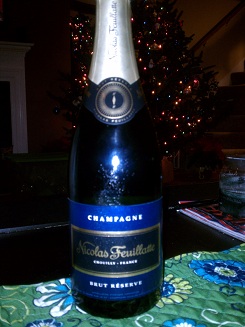
Nicolas Feuillatte Brut Reserve

ImageImage

Happy New Years from Grapestorm! This year on New Year’s Eve I picked up a bottle of Nicholas Feuillatte Brut Reserve Champagne on the way home from skiing. There’s a lot to cover when talking about Champagne:

In order for a wine to be called Champagne it must come from Champagne, France. All other sparkling wines world wide may not be called Champagne technically…although many people make that mistake on a regular basis. Champagne located north of Burgundy and East of Alsace.

Champagne is typically made with a blend of Chardonnay and Pinot Noir grapes. You might be wondering how they make white wine with a red wine grape but the secret is how they press the grapes. They press them gently and separate the juice from the skins during fermentation therefore yielding a white wine. There are other varietals allowed in Champagne but they are rarely used: Arbanne, Petit Meslier, Pinot Blanc, Pinot Gris, and Pinot Meunier.

Some versions of Champagne are made entirely from one grape or another. Blanc de Noirs refers to wine made from red grapes (Pinot Noir or Pinot Meunier) while Blanc de Blanc refers to wines made from 100% Chardonnay. Rose Champagne is made by either a) allowing skin contact during fermentation or b) simply adding still (non-sparkling) Pinot Noir to the mixture. In fact Champagne is one of the only regions that allows Rose production by addition of wine and not skin contact.

This leads to another important fact about Champagne: There aren’t vintages on the bottles. Almost all Champagne is produced by mixing grapes from various vintages. Producers are more concerned with consistency rather than having a unique wine from year to year. This is one of the reasons they may add still Pinot Noir to produce Rose rather than gamble with skin exposure as that may come out different year to year. There are exceptions to this rule though and every so often there is a spectacular vintage a Millesime is declared and producers will bottle and label  their wines with only grapes from that vintage. These wines are expected to be of higher quality and warrant cellaring where regular Champagne is meant to be consumed immediately.

The label will tell you whether you’re buying a sweet or dry Champagne:

Brute Nature (no sugar added)

Extra Brut

Brut

Extra Dry

Dry

Demi-Sec

Doux (Sweet)

The most common variety you’ll find on the shelf is Brut. Also important is that many producers are known for making different styles ranging from light to medium to full bodied wines. Unfortunately the only way to know what you’re buying is to learn the producers or ask for help at the store.

Lastly, let’s talk about how to properly open a bottle of Champagne. We always see in the movies or on TV people popping open the bottle, cork goes flying, and fizz erupting from the bottle. That’s not how you do it….all that fizz/foam is wasted bubbles and wine! Here’s how to do it properly: First step is to remove enough of the foil to expose the wire net. Carefully remove the wire while maintaining pressure on the cork. While holding the cork rotate the bottle in your hand at an angle to gently ease out the cork. While it may not be as glamorous and fun…this will prevent cork missiles, flat, and wasted wine.

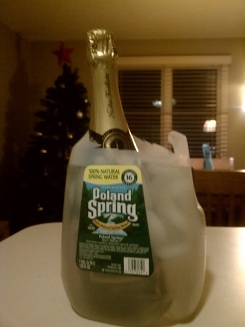
Champagne is meant to be served chilled just like other white wines. The classic method is an ice bath of 50% mix of ice/water for 20-30 minutes. However here at the Grape household we like to get creative sometimes. Since we don’t drink Champagne often we don’t have an ice bucket so I made my own while Moby was still at work. I took a gallon water contained, cut off the top, and voila…instant ice bucket.

colonelgrape: 81. I’m not a huge Champagne fan, most bottles just don’t do it for me. It has 2 strikes against it before I even open a bottle: I don’t like Chardonnay or carbonated beverages too much. That being said I can appreciate a good bottle when I taste one and nothing says celebration like Champagne. This bottle was definitely on the dry side of Brut but it was still fun. Moby definitely enjoys her bubbly more than I do but for New Year’s, a wedding, a Birthday, or a major accomplishment no drink does it better. If you’re looking for a light-medium body Brut Champagne you’ll do well with this $35 Nicolas Feuillatte. Personally I think I’d be happier with a dry or demi-sec to cut the Chardonnay flavor a bit.

MobyGrape: 80.  I’ll be the first to admit, I do enjoy a nice glass of the bubbly.  There’s just something about drinking a glass of champagne (or sparkling wine, if you’re a snob like the Colonel) that makes you feel happy and fancy.  Even if you’re drinking it while in your pajamas eating pizza, (not that I’ve ever done that) you feel like you’re a Bond girl.  This was definitely a drier champagne which isn’t really my style, however it didn’t stop me from drinking 3/4 of the bottle because it still had a nice flavor.  If you want something sweeter though, steer clear.  Happy new year to me!

2011 Louis Jadot Macon-Villages

Image

For our main course we had alfredo with salmon and peas which came out excellent. We served the 2011 Louis Jadot Macon-Villages. This is an un-oaked Chardonnay from the Maconnais in Burgundy. It’s well documented that we aren’t huge Chardonnay fans here on Grapestorm but there are so many different regions producing different types Chardonnay that it’s our duty to try them all. Maconnais is known for its un-oaked Chardonnay just like Chablis but with a different flavor profile due to geography.

Just like in other French regions there are levels of wine:

Macon: Basic appellation that can be used for any Maconnais wine.

Macon-Villages

Macon + Village Name

Pouilly-Fuisee

Pouilly-Fuisse is the highest end wine made in Maconnais and will fetch a hefty price. I’ve been told that a simple Macon-Villages is often a much better value at anywhere from $8-$15 with a reputable Pouly Fuisse costing upwards of $50.

MobyGrape: 70.  In the immortal words of someone very dear to me, “Is this supposed to be good?”.  Another chardonnay I didn’t really enjoy, this one was just very, very mild and light, if I were trying to sell it to you I would call it “crisp and refreshing”.  If I were being honest I’d call it well-hydrated rat piss.  Still drank it though, since we were eating a delicious dinner with it and it was so barely-there it didn’t really matter one way or the other.

colonelgrape: 70. I completely agree with Moby on this one. A very light, mild, fruity, and young un-oaked Chardonnay. It came as advertised I just don’t really like it…it’s too boring. I definitely prefer this to oaked Chardonnay, that’s for sure, but I’m just not a fan. If I want a white with a bigger meal I’m having a Gewurztraminer or even a simple Picpoul/Sauv Blanc/Riesling over a Chardonnay.