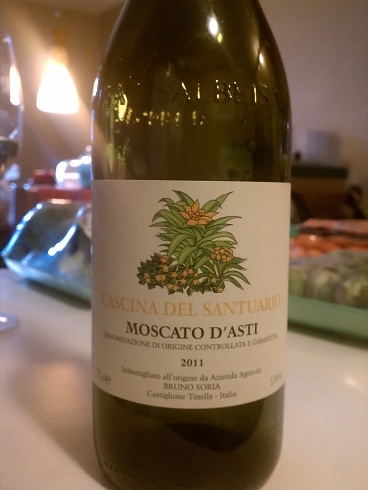
2011 Soria Bruno Cascina del Santuario Moscato d’Asti

Image

Moscato d’Asti is an Italian sparkling white wine made from a white variety of Muscat grapes called Muscato Bianco. It’s typically thought of as a desert wine due to it’s sweetness and low alcohol content (5.5% in this case) however I also think it can work as an aperitif. Here’s where it gets slightly confusing:

Asti: A region of Italy in Piedmont; Also a sparkling white wine made from Muscato Bianco

Moscato d’Asti: Like Asti (the wine) however less sparkling and less alcohol. Also made from Muscato Bianco.

Aperitif: Alcoholic beverages normally served before a meal.

As you can see Asti can refer to the region of Asti or the sparkling white wine. I have no idea why they decided to do it that way but they did and now we have to deal with it. What’s the difference between Moscato d’Asti, Asti, and Champagne? Two things: First, Champagne can only come from the Champagne region in France, regardless of the wine itself. Second, the true difference is the way the wine gets it’s sparkling properties. Champagne uses secondary fermentation and Asti wines use the Charmat method. It’s a long and detailed story describing the methods but if you’re ever curious look them up!

We decided to open this bottle as an aperitif on Christmas eve since two of our guests are not into non-sweet wines (I’ll have to work on that). We enjoyed some nice honey goat cheese and crackers and the wine was great:

MobyGrape: 89. I thoroughly enjoyed this guy!  I tend to enjoy
the sweeter varities of sparkling wines, and this was just sweet
enough without being overbearing, and wasn’t too fizzy so it was
perfectly fine to have with appetizers or really light meals.  It was
the Goldie Locks of sparkling wine for the evening.  Just right.  I
feel like this would pair well with french toast, and it’s light
enough to enjoy with a nice brunch.

colonelgrape: 85. Full disclaimer: I am not a huge sparkling wine fan as we know so take my rating with a grain of salt. That being said…this Moscato d’Asti was quite good. I liked how it was only semi-sparkling compared with Champagne or Asti…sometimes the bubbles are too much for me, I don’t even like soda that much. It had nice fruit notes and was very mild. I personally prefer Port, Sauternes, or Ice Wine for my desert wines but this would do nicely and it worked well as an aperitif. I don’t think I’d want it with a meal though, it’s so mild I think it would be overpowered easily.
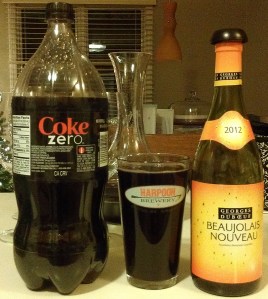
Beaujolais Nouveau Redemption Challenge #1

All right ladies, the old ball and chain is keeping you waiting and you proooomised to wait for him to drink the good wine that evening.  But you’ve had a long day and a beer just won’t cut it.  What’s a thirsty gal to do?

Calimocho

There’s only two ways for terrible wine to redeem itself in my book. This is one of them. Meet the Calimocho. I picked this up over in Spain, thanks to an unnamed bartender who unknowingly changed my drinking life forever (for the better). I believe the conversation went something like this…

Me: “Señor, how do you make this heavenly bebida?”
Bartender: “Guapa, this is an ancient Spanish recipe. Come with me, I will make passionate love to you and share all of my secrets. I can’t believe it’s not butter!”
Me: *Swooning* “Sí, sí!”

Ok, so that’s not really how it happened, and my fantasies may be getting a little mixed up. It was more like I asked what the hell I was drinking in broken Spanish (give me a break, it was the beginning of the trip), and I was told to use the cheapest red wine I could find, and the nicest cola I could, and mix them together 1 to 1.

Mind = Blown

Does it sound disgusting? You betcha! Is it glorious? You have no idea! I’m trying to find the silver lining in the Beaujolais Nouveau cloud. And I have to say it turned out pretty well. I went straight up half wine, half Coke, but you can change up the proportions depending on how you’re feeling. So congratulations Beaujolais Nouveau, you have a new lease on life in my fridge! Salud!

2005 Chateau Laribotte Sauternes

ImageImage

Bostrytis Cinerea you beautiful devil. Sauternes is a world famous sweet white wine produced in the…get ready for some geography…Sauternes region located in the Graves region of Bordeaux, France. This wine is made from Semillon (upwards of 90%), Sauvignon Blanc, and Muscadelle grapes affected with Bostrytis Cinerea which in the wine world is known as Noble Rot. While rotting fruit may not look appetizing, Noble Rot causes magic to happen in Satuernes. The rot dehydrates the grapes leaving highly concentrated and very sweet grapes for winemakers to work with. The result is one of the most unique and most expensive wines in the world.

Fun Sauternes facts:

– Exceptional aging potential with exceptional vintages having potential beyond 100 years.

– Chateau d’Yquem is widely regarded as the best producer in the world.

– Since it’s produced in such a small area inferior vintages are sometimes completely disgarded. How often does this happen? at Chateau d’Yquem it’s only happened 10 times: 1900, 1915, 1930, 1951, 1952, 1964, 1972, 1974. 1992, and 2012.

– Sauternes has the honor of being the most expensive wine ever sold.

– Typically sold in 375 ml bottles although regular sizes are available in some cases.

– In 2006 Chateau d’Yquem sold a 135 year vertical tasting from 1860-2003 for $1.5 million dollars.

– In 2011 a bottle of 1811 Chateau d’Yquem sold for for $117,000 to a French sommelier.

– Thomas Jefferson is on record ordering 250 bottles of the 1784 Chateau d’Yquem for himself and George Washington.

So what’s all the fuss about? Sauternes attains a perfect balance of sweetness and acidity along with flavor depth to provide a unique experience. It is full bodied and has a wealth of fruit and nut flavor…it reminds me of a more complex and full mead. This wine will delight your palate for several minutes with it’s long and smooth finish. Served at the right temperature (around 52 degrees) this is truly the nectar of the Gods. Sounds like the perfect desert wine right? Don’t be fooled! While it’s a great desert option if you’re not into port, Sauternes will pair well with a variety of foods….don’t be afraid to have it with your dinner.

Onto the relatively no-name Chateau Laribotte Moby and I tried the other night. Shockingly we couldn’t afford a $250 bottle of 2005 Chateau d’Yquem so we went with the $20 option. At $20 this is considered to be an excellent “value” Sauternes so expect to pay AT LEAST $20 for a 375 ml bottle from a decent Chateau. Lists of reputable Chateaus can be easily found online.

I’ll help you out with the pronunciation so you don’t sound silly at the store. Say it like this: Soh/tehrn. Kind of like turn but with an eh sound instead. It’s very French…why not just spell it that way?

colonelgrape: 94. This wine was unbelievably good. Light, fresh flavors of melon and vanilla along with a honey, nuts, and minerals. There was sweetness and acidity with a full body that balanced nicely, the wine coated our glass as we swirled and observed it. The finish was incredibly long, lasting a couple minutes. I’m told this is actually not a very sweet Sauternes so I can’t wait to get out there and try some different examples. Unless you live under a rock and hate sweet things, you 100% need to spend the money and try a Sauternes.

MobyGrape: 93. This stuff was awesome.  At first I was 100% convinced the Colonel was trying to trick me and snuck mead in my glass to see if I could tell the difference.  It was very sweet and had a touch of honey flavor to it.  If you don’t like wines like this (and that means there’s a problem with you), don’t even bother.  I would serve this as a dessert wine, I’m not sure if that’s what you’re supposed to do with it but it’s like drinking rich liquid candy.  I feel like food would ruin it somehow, but who knows, it might go well with a super strong stinky cheese?  Their powers combined might make for a Captain Planet-esque dining experience.  Except for Heart, I mean really, what was he good for?  Anyways, who knew rotting grapes could taste so good!  Go out and get some of this!

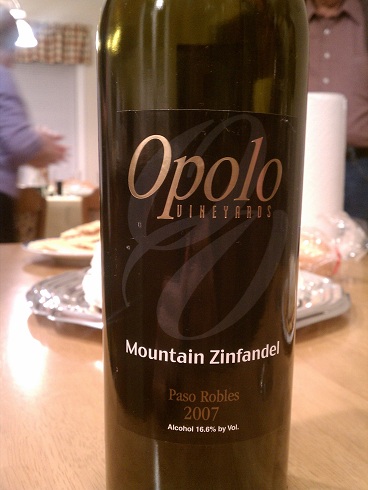
2007 Opolo Vineyards Mountain Zinfandel

Image

No not that White Zinfandel crap you see people drinking (although it is made from Zinfandel grapes, it’s an off-dry/sweet grape juice if you ask me). This is a traditional huge California Zinfandel. I’m not sure if you can make it out in the picture but you read that label correctly: 16.6% alcohol content. Zinfandel is known for two things: big flavor and high alcohol content. If you aren’t ready to take the bull by the horn then this wine might not be for you.

Some fun Zinfandel facts:

– 3rd most harvested Grape in California behind Cabernet Sauvignon and Chardonnay

– Grown in Croatia as Crljenak Kaštelanski and in Italy as Primitivo.

– Controversy over grape DNA (yes, grape DNA): Scientists conducted DNA tests to find the roots of Zinfandel after realizing that both the Italian and Croatian grapes taste remarkably similar to Zinfandel. The result? Both have a common ancestor grape…Tridibag…another Croatian grape that has been around for centuries. Zinfandel,  Crljenak Kaštelanski, and Primitivo have been regarded as synonyms for many years but in the United States that’s no longer acceptable.

– High sugar content in the grapes leads to extremely high alcohol content

– Often referred to as “Zin”.

– Depending on where the grapes are grown the wine can have very different flavor. The cooler climates lead to jammy and fruity wines while the warmer climates lead to spicier wines.

On to the 2007 Opolo Vineyards example. Moby and I brought this bottle to a birthday party and unfortunately we really didn’t get to try enough of it to form a solid opinion. There were 6 people trying it and then the last 1/4 of the bottle was lost when someone dropped it. Whoops! There was a broken wine glass, wine in the dip, wine on the cake, a minor hand injury…it lead to much comedy throughout the night so it was still fun. Thankfully it was only a $20 bottle!

But what did it taste like? It was very very jammy and had huge fruit flavor. This was a seriously big wine. You could really notice the 16.6% alcohol content also. I nursed my glass through the salad and lasagna since we were out of wine but it turns out it was a good thing because this wine 100% needs food. WIthout food you may as well schedule a nap after your first glass because this wine will beat you senseless.

All that being said I actually don’t mind Zinfandels. Big wines can be fun in the right environment, you just have to know what you’re getting into. Zinfandels don’t have a true calling like Cabernet and steak…but if you’re looking for a big wine other than Cabernet give Zinfandel a try.

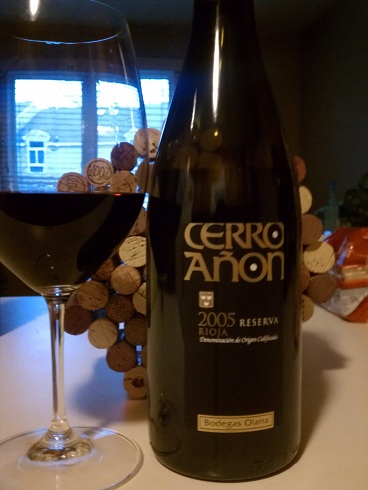
2005 Cerro Anon Rioja Reserva

Image

Rioja is one of the most common Spanish iwnes you’ll find on the shelves at the local store. It’s typically a blend of Tempranillo, Grenache, Graciano, and Carignan grapes with Tempranillo being the primary grape (usually 60% ish). Most Rioja wines are aged in oak barrels for various amounts of time depending on the classification. There are 4 classifications:

Rioja: Aged in oak for less than 1 year.

Crianza: Aged at least 2 years and at least 1 year in oak.

Rioja Reserva: Aged at least 3 years and at least 1 year in oak.

Rioja Gran Reserva: Aged at least 3 years and at least 2 years in oak.

Kind of like French wines, you may not see all the information you’re looking for on the labels. What’s the blend? What classification is it? It’s a European thing. In America we label our wines by varietal whereas in Europe it’s by region and you’re just supposed to know them. I’m getting there with my French wines but Spain is project for the distant future. What can you take away from all this information? Rioja is good and you should try it.

colonelgrape: 82. We found this 2005 Reserva for $25 so it’s a very affordable wine. The wine itself was a very dark purple and had good spice, earth, and tannins…probably why it worked so well with the rustic Italian food we had. There’s something about Spanish wine that I can’t quite put my finger on…I do enjoy Rioja I just can’t figure it out yet. When I have Tempranillo at tapas bars I get the same feeling. Maybe Tempranillo just isn’t my thing? I don’t know yet but the bottom line is that it’s a solid wine and I’d recommend it if you’re looking to branch out into Spain.

MobyGrape: 88. I think they found a way to bottle Enrique Iglesias’ primo.  It smelled like regular wine at first, and then the longer it sat out I guess it smelled a little funkier (but at that point, who really cares), but this is a great little wine.  Tastes a little fruity up front but it’s nice and smooth.  The longer it breathes the more bite it picks up.  For a while I thought it had a little caramel flavor but then again there’s an excellent change I’m only imagining that.  This was perfectly fine with food, and it’s perfectly fine on its own.  What’s even more perfect is that the Colonel had to go and the rest of the bottle is allllll mine.